

DeepSeek V4.1 Flash: agent benchmarks vs GPT-6.1 Sol and Opus 5.5
DeepSeek shipped V4.1 Flash on 10 September 2026. A week later the API track moved again to V4.1-Flash-1017 (17 October 2026). Both are multimodal MoE models built for agents: million-token context, native vision, and a causal encoder-decoder stack that keeps prefill at about 8B active parameters and decode at 16B. Weights are MIT licensed on Hugging Face.
This note is for firmware leads, platform engineers, and procurement on connected-device programs. We compare published scores against GPT-6.1 Sol and Claude Opus 5.5, the closed frontier pair your team likely already pilots. Numbers come from DeepSeek’s launch post, the model card, API changelog, and Artificial Analysis. Harnesses differ. Treat every table as directional, not a single horse race.
What changed in the architecture
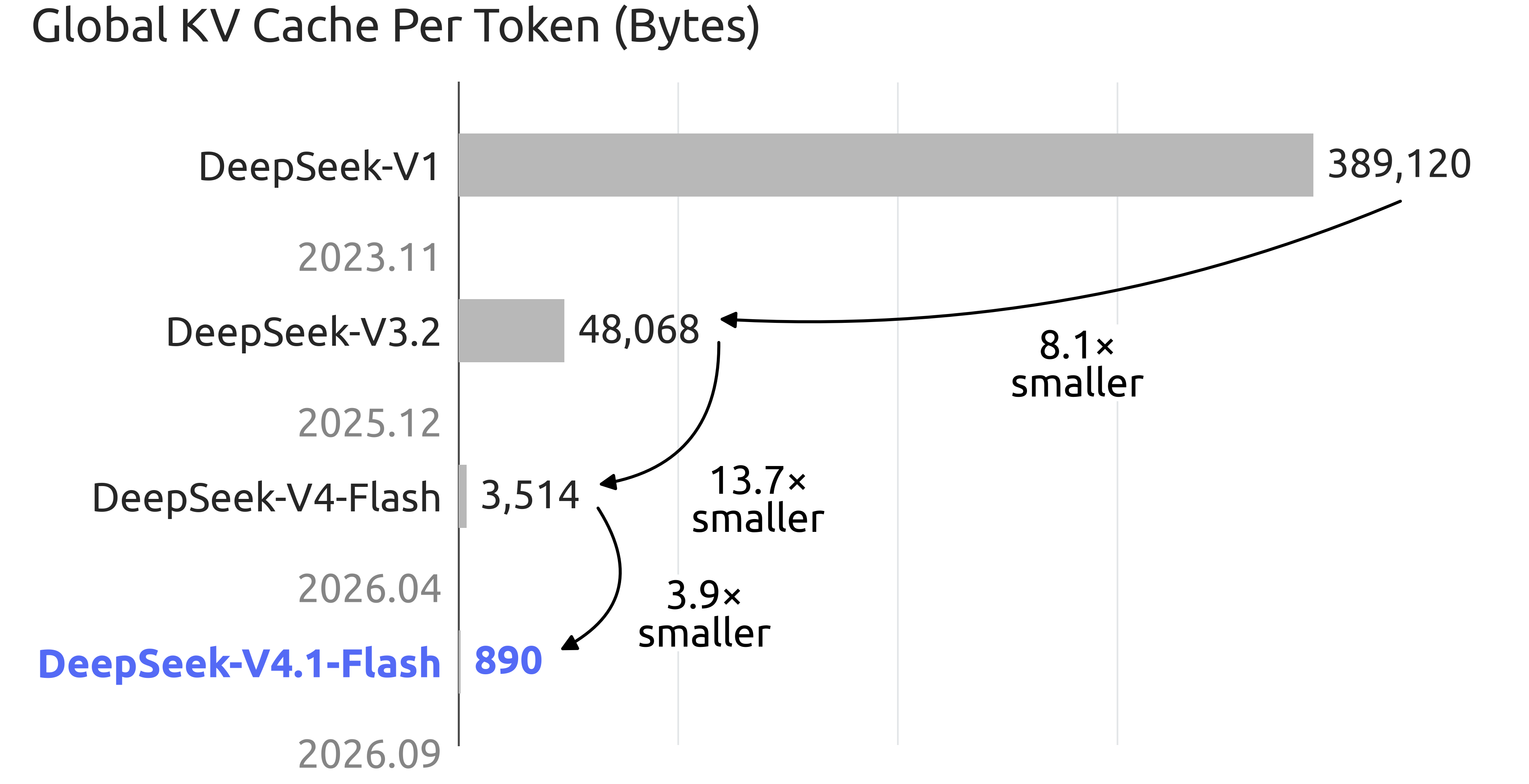
V4.1 Flash is not a thin distill of V4 Pro. DeepSeek’s CED layout runs a 20-layer causal encoder and a 20-layer decoder. Global KV cache is projected from encoder states, not stacked per decoder layer. Compressed Sparse Attention 2 and FP4 KV caching cut persistent KV to about 890 bytes per token, roughly one quarter of V4 Flash. For agent loops that re-read the same repo or log bundle, that is real money on cache-hit billing.
Reasoning effort is a dial from 1 to 100 on the API. Published agent scores use max effort, DeepSeek Harness minimal mode, and up to 1M tokens unless the benchmark specifies another scaffold.
Benchmark charts worth pinning
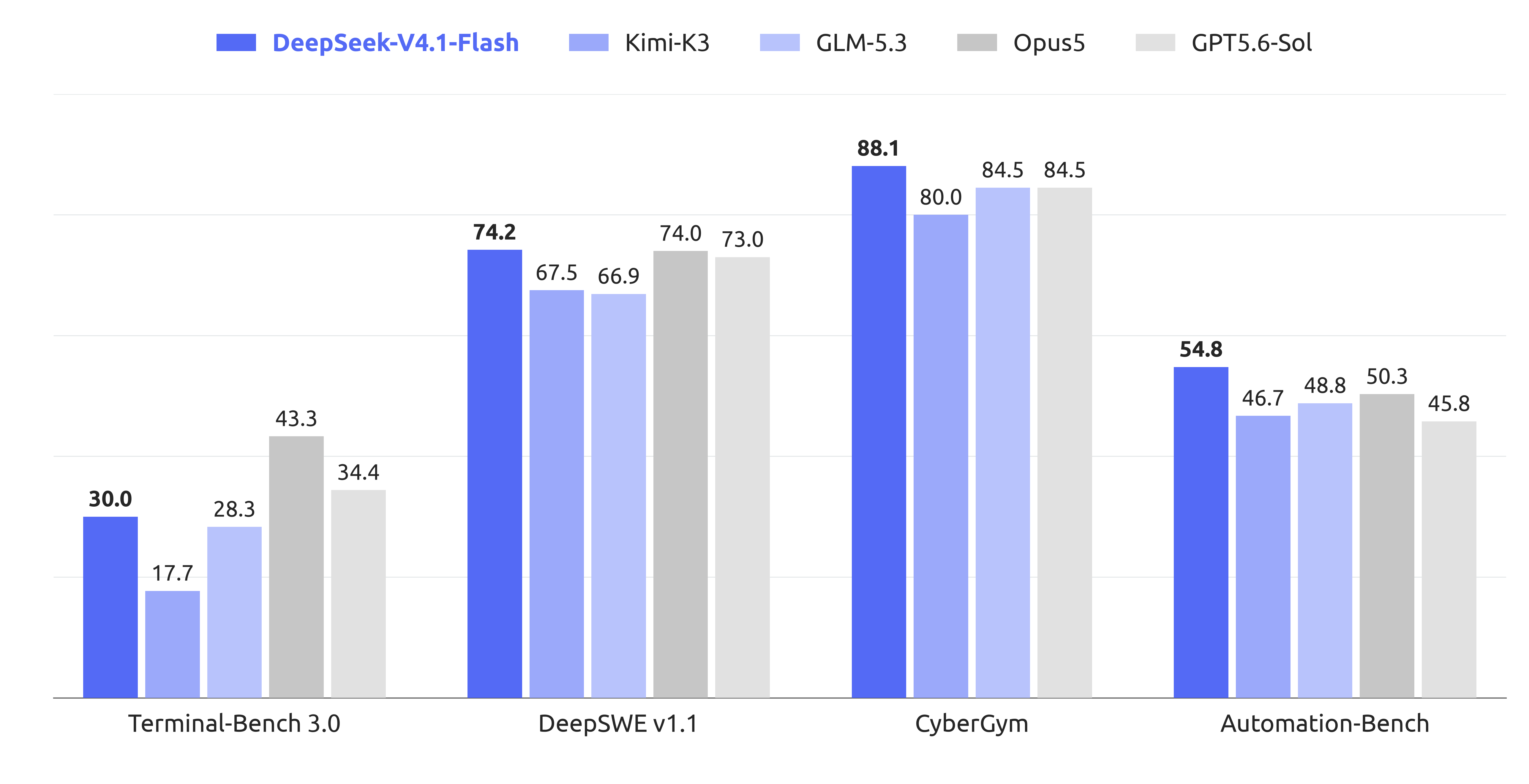
DeepSeek’s own agentic chart is the fastest read for where Flash wins on coding agents versus earlier DeepSeek tiers and Western closed models at launch comparators.

DeepSeek harness vs frontier APIs (launch table)
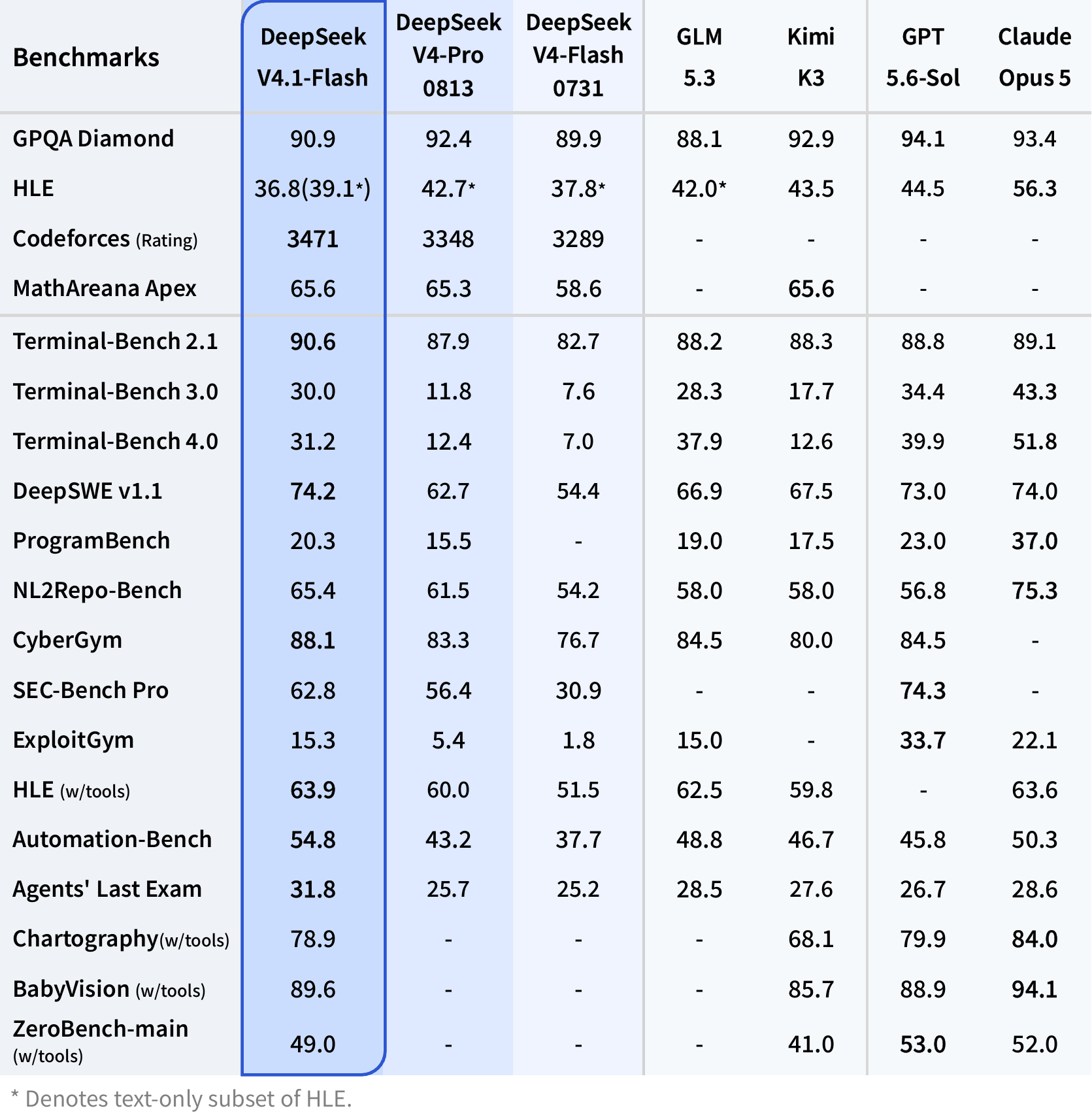
DeepSeek’s September instruct table reports max reasoning effort on its own harness. It labels comparators as GPT-5.6 Sol and Opus-5.0, the frontier names current when V4.1 Flash shipped. We map the same rows to how you should read GPT-6.1 Sol and Opus 5.5 today in the next section.
| Benchmark (Pass@1 unless noted) | Claude Opus 5.0 | GPT-5.6 Sol | DeepSeek V4.1 Flash | V4.1-Flash-1017 (API) |
|---|---|---|---|---|
| Terminal-Bench 2.1 | 89.1 | 88.8 | 90.6 | — |
| Terminal-Bench 4.0 (long horizon) | 51.8 | 39.9 | 31.2 | 42.3 |
| DeepSWE v1.1 (resolved) | 74.0 | 73.0 | 74.2 | 77.0 |
| AutomationBench | 50.3 | 45.8 | 54.8 | 60.5 |
| Agent's Last Exam | 28.6 | 26.7 | 31.8 | 35.4 |
| CyberGym | — | 84.5 | 88.1 | — |
| GPQA Diamond | 93.4 | 94.1 | 90.9 | — |
| HLE (text subset †) | 56.3 | 44.5 | 36.8 (39.1†) | 42.6 (44.0†) |
| NL2Repo-Bench | 75.3 | 56.8 | 64.0 | 68.2 |
Sources: Hugging Face model card (September rows); DeepSeek API changelog (17 Oct 2026 rows). † Text-only HLE subset per DeepSeek footnotes.
How GPT-6.1 Sol and Opus 5.5 compare on third-party indexes
Artificial Analysis Intelligence Index v4.3.2 is a blended score across professional PDFs, automation, terminals, science exams, and long context. On that index at max effort, Opus 5.5 leads GPT-6.1 Sol (58 vs 52). GPT-6.1 Sol wins on cost per task at several effort tiers.
On overlapping agent slices (same AA harness, not DeepSeek’s):
- Terminal-Bench 4.0: Opus 5.5 (max) 59.6%, GPT-6.1 Sol (max) 56.1%. DeepSeek’s Oct 17 self-reported TB 4.0 is 42.3% with Claude Code framework per changelog. Flash is competitive on short terminal tasks, not yet on the longest horizon rows.
- AutomationBench-AA: Opus 5.5 (max) 69.5%, GPT-6.1 Sol (max) 64.9%. DeepSeek AutomationBench (official scaffold) reached 60.5% on the 1017 build.
- Humanity's Last Exam: Opus 5.5 (max) 61.4%, GPT-6.1 Sol (max) 52.9%. DeepSeek HLE without tools is still lower (42.6% on 1017 text subset).
Insight for hardware teams: Opus 5.5 and GPT-6.1 Sol still own the broadest reasoning and long-horizon agent scores in AA’s bundle. V4.1 Flash punches above its price on repo repair and terminal-style coding agents in DeepSeek’s own harness, especially after the October refresh. Pick the model to match the job: compliance-heavy reasoning on closed APIs, high-volume log triage or CI fix loops on Flash API or self-hosted weights.
Cost and deployment shape
DeepSeek cut API pricing at launch and routes legacy deepseek-v4-pro traffic to Flash at Flash rates during the transition window described in their changelog. Open weights mean you can run on your own GPU fleet under MIT terms, which matters for NDA firmware and factory VLANs that cannot send traces to a US API.
KV compression is the hidden spec for agents. A firmware repo plus last week’s UART logs can eat hundreds of thousands of tokens. Smaller KV lowers HBM pressure and cache-hit charges when the same context is revisited every tool call.
Cool workloads that map to real programs
These are the tasks DeepSeek highlights and third parties already score. They are the ones we see OEM and ODM customers ask about when they add an agent beside their existing cloud.
1. Repository surgery (DeepSWE / Terminal-Bench)
DeepSWE v1.1 is a software-engineering repair suite. V4.1 Flash at 77.0% resolved on the Oct 17 build sits at or above GPT-5.6 Sol and Opus 5.0 in DeepSeek’s September table. Practical use: point the harness at a fork of your Zephyr or ESP-IDF tree, file a bug against a failing CI target, and let the agent propose a patch series with tests. You still own merge and hardware sign-off.
2. Greenfield service repos (NL2Repo-Bench)
NL2Repo scores how well a model scaffolds a new codebase from a spec. Flash improved from 64.0 to 68.2 on 1017. Practical use: generate a reference MQTT bridge or factory-test daemon from your protocol doc, then hand the repo to your Hong Kong team for hardening and DFM review.
3. Security and reliability drills (CyberGym)
Flash reported 88.1% on CyberGym versus 84.5% for GPT-5.6 Sol in DeepSeek’s launch matrix. Practical use: red-team your OTA update handler or TLS stack in a sandbox, not on production lines.
4. Multimodal datasheet and chart QA
Vision scores on the card include DocVQA 95.6 and Chartography with tools 78.9 (83.0 on 1017 per changelog). Practical use: ingest a supplier PDF for an PMIC or sensor, extract table fields into JSON for your PLM, and flag pin conflicts before you spin a respin.
5. Structured extraction without a custom parser
Community ExtractBench runs on the DeepSeek API report mid-80s to low-90s accuracy on short and medium documents. Practical use: turn inbound BOM spreadsheets and qualification forms into validated records for your ERP workflow.
6. Automation across business tools (AutomationBench)
At 60.5% on Automation-Bench v1.0.6 (1017), Flash is aimed at multi-step flows across calendars, spreadsheets, and ticketing. Practical use: prototype an internal agent that files an NPI checklist when a Git tag ships, still with human approval on customer-facing steps.
Where frontier models still win
GPT-6.1 Sol leads on several AA professional slices such as GDP.pdf at max effort (31.0% vs Opus 5.5 26.2% on that row). Opus 5.5 leads blended intelligence, Terminal-Bench 4.0 in AA’s harness, and raw HLE. If your agent must read 200-page contract PDFs or run month-long planning tasks, keep a frontier API in the loop and use Flash for high-volume coding and log work.
None of these models ship your PCB. They compress time on analysis, scaffolding, and first-pass fixes. Production still needs your test jig, your certifications, and your factory traveler.
What we recommend on an OEM program
- Split roles: frontier model for customer-facing reasoning and legal review; Flash (API or self-hosted) for CI agents, log triage, and internal tooling.
- Log tool calls and file hashes the way you log OTA events. Reasoning traces may be shorter than older models. The audit trail is the harness, not the chat prose.
- Benchmark on your repo and your PDFs before you change the BOM workflow.
- If you need agents on the device, not only in the cloud, pair model choice with a bounded tool spec. That is the Physical AI lane.
Sources: DeepSeek V4.1 Flash launch and technical report; Hugging Face model card; DeepSeek API changelog (10 Sep and 17 Oct 2026); Artificial Analysis GPT-6.1 Sol vs Claude Opus 5.5 comparison. We are not affiliated with DeepSeek, OpenAI, or Anthropic. We did not independently reproduce benchmark runs in our lab for this article.
