

Microduck at GTC Berlin: Jensen Huang, Hugging Face, and a $399 lesson in Physical AI
At GTC Berlin on 21 October 2026, Jensen Huang walked four palm-sized duck robots onto the keynote stage and talked to them like a lab director, not a comedian. The machines are Microduck, an open-source biped from Pollen Robotics (Hugging Face’s robotics team in Bordeaux). Huang asked them to sit, take a nap, and try a somersault. Three ducks dropped when he said nap. One needed extra coaxing. Another faced the wrong way until he told it to pay attention. Reuters treated the moment as proof that voice-driven physical AI still fails in public, which is fair.
For hardware founders the duck is still the story. Microduck is a 25 cm, 15-motor platform priced at $399 (introductory, before tax and shipping). It ships with trained behaviours, a game controller, and a software stack you can retrain. NVIDIA tied the demo to Isaac Lab 3.0, sim-to-real training, and the same day’s Hugging Face blog post with NVIDIA. This note covers the keynote, the tech, Hugging Face’s role, and what we think OEM teams should copy (and avoid).
What happened on stage
Huang used the ducks to argue that Europe still leads on precision mechatronics while AI supplies the brain. NVIDIA’s press release the same day names Microduck as a small open-source robot for students and developers to train and share physical behaviours, built with Hugging Face and Pollen using Isaac Lab, Isaac Sim, and Newton.
The live commands were simple natural-language style orders: sit, stand, nap, somersault. That matches how Pollen markets the product: playable before you write code, then policies you own. The failures were honest. Real servos, real latency, real carpet. Huang’s reaction (laughing, then scolding a distracted duck) is what every robotics PM sees in first field trials, just with better lighting.

The robot: design and specs
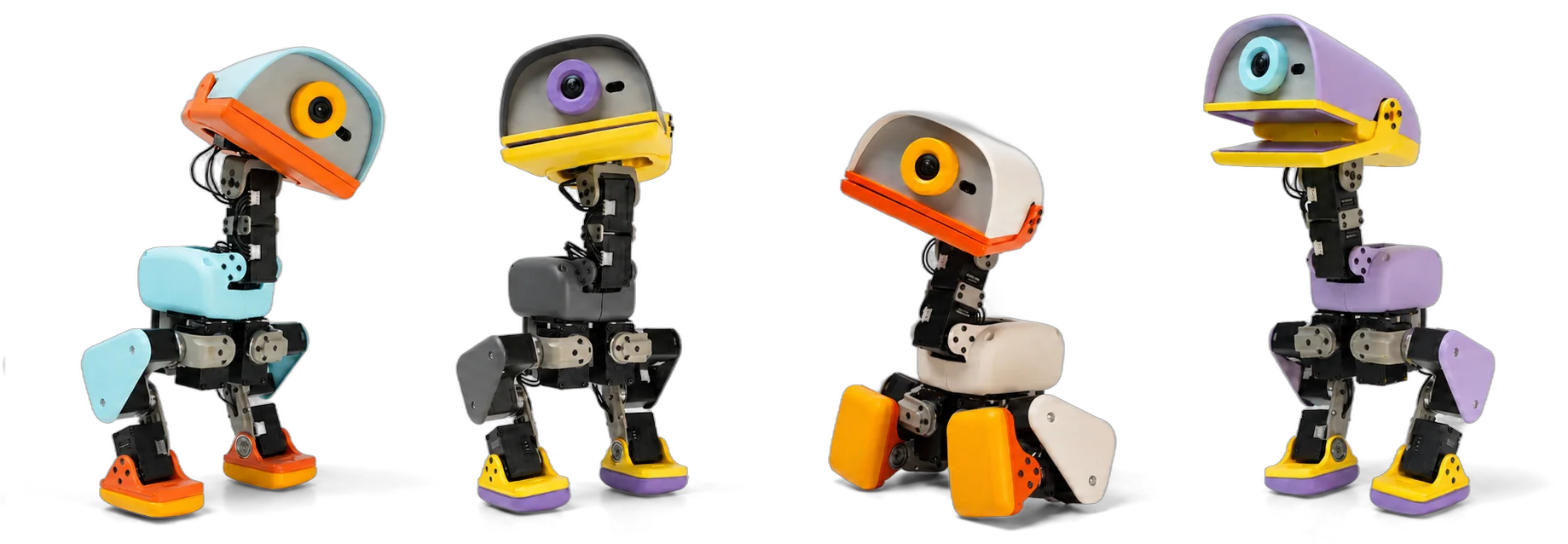
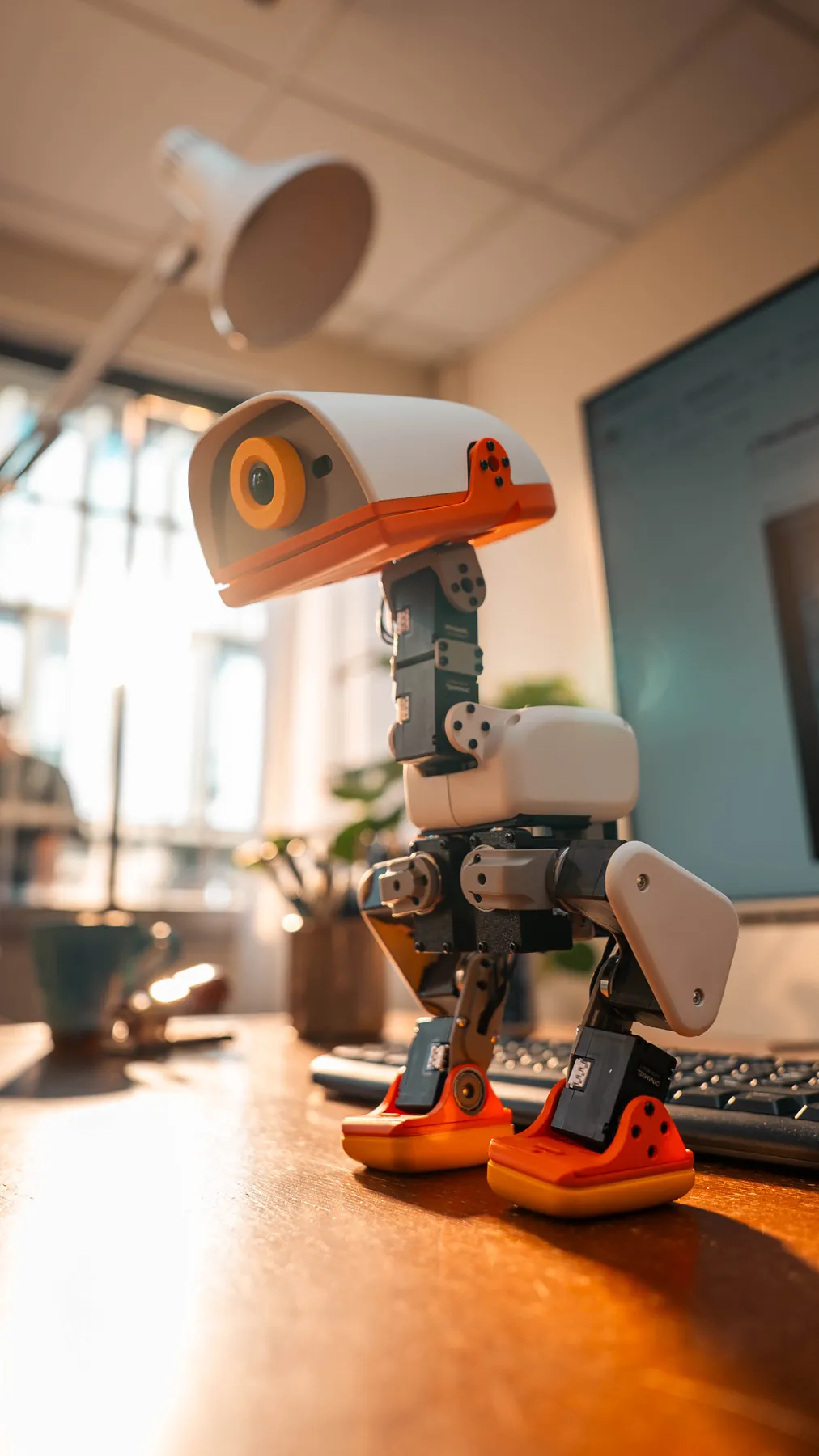
Pollen describes Microduck as a waddling biped with an articulated beak, not a toy quadcopter in a costume. The press kit lists the headline numbers:
- Size: 25 cm tall, 14 cm wide, under 800 g.
- Actuation: 15 DOF across legs, head, and neck.
- Sensing: front camera, compact LiDAR (8×8 time-of-flight), two IMUs, NFC in head and beak.
- Compute: Rockchip RK3566 with an AI accelerator, 1 GB RAM, 32 GB storage.
- Runtime: removable NP-F550 battery, about one hour depending on behaviour.
- Shells: four colourways at launch (Cream, Graphite, Lavender, Sky). Software is open; mechanical CAD is not open hardware.
Shipped policies include walk, sit and stand, kick, grab, roller skating (with accessory rollers), and get-back-up. The design goal is visible: cute enough for desks, serious enough for RL homework.
Hugging Face: hub, arena, and sim
Microduck is a Hugging Face story as much as an NVIDIA story. Pollen joined Hugging Face in April 2025 and positions Microduck as “running a model on real hardware” with the same publish-and-fork culture as model weights.
- Training twin: microduck-simulator Space for the public sim twin.
-
Policy sharing: export walking policies as ONNX and upload to the Hub; others can download and load them with
robotctlon a physical duck. - Microduck Arena: leaderboard challenges for compatible policies (61 observation dims, 14 actions, 64 MiB max).
-
Isaac Lab path: NVIDIA’s 21 October tutorial walks train-in-sim, play in Newton, export
policy.onnx, deploy via SSH to the robot.
The Isaac Lab task uses 61 observations and 14 joint-position actions, with domain randomization on mass, friction, encoder bias, battery sag, and gearbox backlash so sim policies survive real play. That is the same class of engineering you need on a warehouse AMR, just at duck scale.

The team behind the duck
Pollen Robotics started in Bordeaux in 2016 from former Inria researchers. They built Reachy before Microduck and joined Hugging Face to keep robotics work open and community-driven. The press kit credits the product as Pollen’s second consumer robot after Reachy Mini.
The Hugging Face × NVIDIA article lists collaborators on the Isaac workflow: Antoine Pirrone, Augustin Crampette, Matthieu Lapeyre, Coralie Deplanne, Anne-Charlotte Passanisi, and Thomas Wolf, alongside NVIDIA authors. That cross-company byline is the normal shape of modern embodied AI: French hardware, US compute stack, hub distribution.

What OEM and Physical AI teams should take from GTC
Opportunity: Microduck lowers the cost of learning sim-to-real. You can test ONNX deployment, OTA policy swaps, and arena-style eval before you commit to a custom leg design. Hugging Face gives you distribution; Isaac Lab gives you throughput; Pollen gives you a physical reference.
Reality check: A keynote duck does not certify your factory robot. You still own safety analysis, edge compute choice, wireless reliability, and liability. Pollen’s own disclaimer on stage behaviour applies to your pilot too: use robots safely.
Process lesson: Huang’s nap command failed because behaviour policies are context-sensitive. Build harness tests for every voice or API command you ship. Log failures the way you log OTA rollbacks.
If you are building beyond the desk duck
Microduck is a trainer platform. Industrial Physical AI still needs your mechanics, your certifications, and your factory test fixtures. When you move from $399 dev kits to customer-facing agents on real machines, pair policy work with bounded tools, signed firmware, and hardware you can service.
Sources: NVIDIA GTC Berlin keynote coverage (Reuters, 21 Oct 2026); NVIDIA news release on Isaac platform expansion; Hugging Face blog “Microduck with Isaac Lab 3.0”; Pollen Robotics Microduck site and press kit; Unitree unrelated. We are not affiliated with NVIDIA, Hugging Face, or Pollen Robotics. Reuters photo used with attribution in caption; licensing for commercial reuse is the publisher’s requirement.
